
The Importance of SEO in 2026 is becoming even more significant as search moves from traditional blue links toward AI-powered experiences. Search is no longer simply about entering a few keywords and choosing a webpage. Users are increasingly asking longer, conversational and complex questions, while platforms such as Google are using AI to understand queries, combine information and present answers.
The scale of this shift is already visible. Google reported in 2026 that AI Overviews had more than 2.5 billion monthly active users, while AI Mode had surpassed 1 billion monthly users. Google also reported that AI Mode queries had more than doubled every quarter since its launch.
This raises an important question for businesses: If AI can answer users directly, does SEO still matter?
The answer is not that SEO is disappearing. Instead, SEO is evolving. AI-powered search still needs information from websites and other sources that can be discovered, understood and evaluated. That makes SEO an important part of the infrastructure behind modern search.
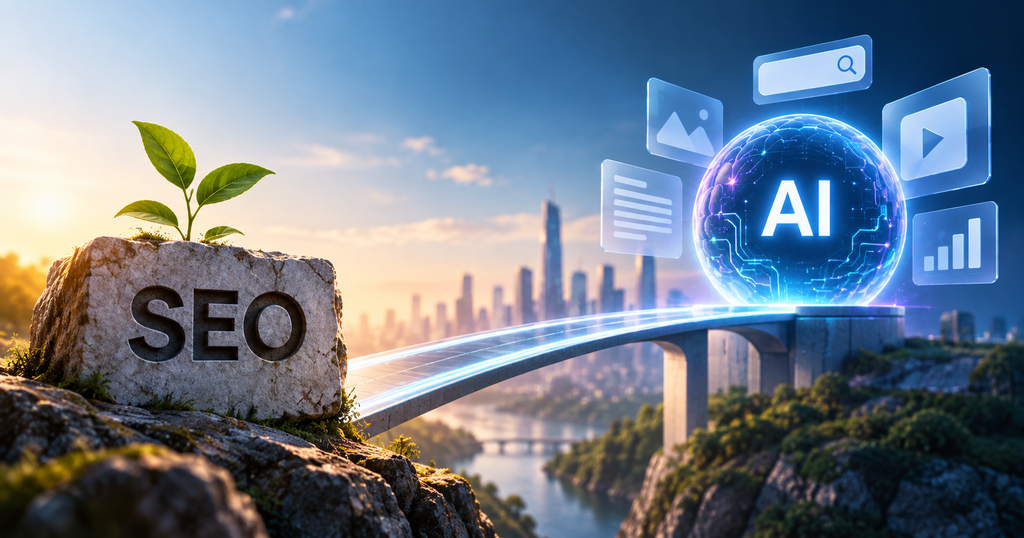
What Is SEO in 2026?
SEO in 2026 is much broader than optimizing a webpage for a specific keyword and trying to reach position one on Google.
Modern Search Engine Optimization Trends are increasingly focused on:
- Search intent
- Helpful and original content
- Technical accessibility
- Topic and entity understanding
- Website authority
- Structured information
- First-hand experience
- User experience
- Multimodal content
SEO Has Evolved Beyond Traditional Rankings
Traditional SEO focused heavily on keywords, backlinks and rankings. Those elements still matter, but businesses now need to think about search visibility across multiple experiences.
A useful way to understand the evolution is:
Traditional SEO → Search Visibility → AI Search Visibility
Content can now be discovered through traditional organic results, featured snippets, images, videos, shopping results, local results and AI-powered search experiences.
Google’s current search ecosystem includes AI Overviews and AI Mode alongside traditional search experiences. Google has also introduced additional insights for website owners to understand when their pages appear in generative AI search features.
Why SEO Is Still Important in 2026
One of the biggest misconceptions surrounding SEO in 2026 is that AI makes traditional optimization irrelevant.
In reality, AI search still needs useful information to work with.
SEO Helps Search Engines Discover Websites
Before content can potentially appear in search or AI-generated experiences, search systems need to discover and understand it.
This makes technical SEO fundamentals important, including:
- Crawlability
- Indexability
- Internal linking
- XML sitemaps
- Page performance
- Mobile usability
- Clear website architecture
A technically inaccessible website cannot easily benefit from content optimization, regardless of how advanced its content strategy may be.
How AI Is Building on Web and Search Data
This is where AI and SEO become closely connected.
AI-powered search does not create knowledge from nothing. It needs information to reason over, compare and present to users.
A simplified model looks like this:
Website → Crawling → Indexing → Content Understanding → Search Systems → AI Search Experience
AI Needs Web Information to Understand Topics
When a user asks an AI-powered search system a complex question, the system may need information from multiple sources.
Google says its AI Search experiences are designed to help people explore relevant websites, original content and supporting links.
This creates an opportunity for businesses that consistently publish useful, trustworthy and original information.
Search Behavior Is Becoming More Conversational
AI is also changing the way people search.
Google reported in 2026 that the average AI Mode query is three times longer than a traditional Search query. Google also found that more than one in six searches in the U.S. now use voice or images, with image searches growing by more than 40% month-over-month in its reported data.
This means businesses need to understand not only keywords, but also:
- Questions
- Context
- Intent
- Problems
- Comparisons
- Follow-up searches
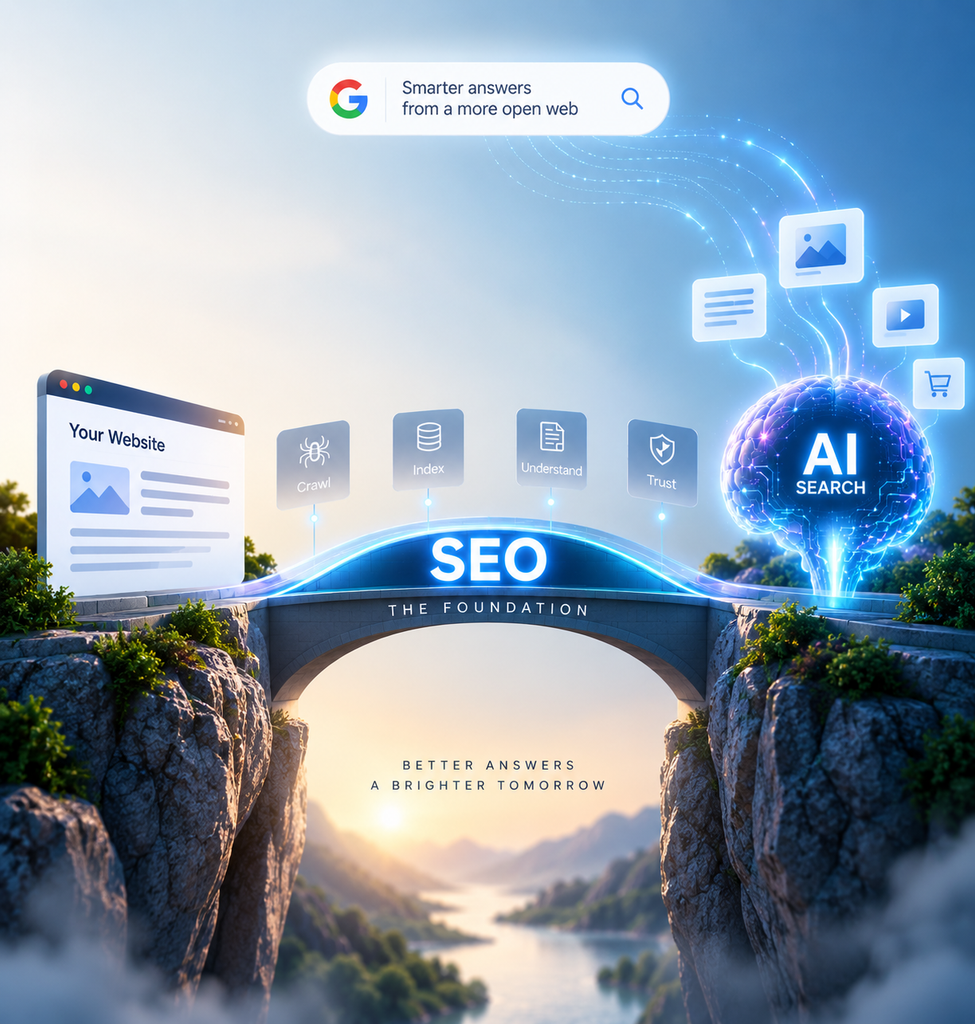
AI and SEO: What’s Changing?
The relationship between SEO vs AI is often presented as a competition. A more useful perspective is that AI is changing how search visibility works.
| Traditional SEO | AI-Powered Search |
| Keywords | Topics, entities and intent |
| Ranking pages | Visibility and references |
| Short queries | Conversational queries |
| Blue links | AI answers plus links |
| Single-result discovery | Multi-source responses |
| Keyword-focused content | Helpful, comprehensive content |
| SERP position | Broader search visibility |
From Keywords to Search Intent
A page should not simply repeat a keyword.
For example, someone searching for:
“SEO for e-commerce”
could be looking for:
- An SEO strategy
- Technical recommendations
- Keyword research
- Product-page optimization
- Examples
- Tools
- Case studies
Understanding this intent allows businesses to create content that answers the broader need.
From Ranking to Being Referenced
In an AI-powered search environment, being visible may involve more than occupying a traditional ranking.
Businesses should focus on becoming useful sources of information through:
- Original research
- Expert insights
- First-hand experience
- Clear explanations
- Reliable data
- Strong topical authority
SEO for AI Search and Generative Engine Optimization
The rise of SEO for AI search has also created interest in AI search optimization and Generative Engine Optimization, commonly called GEO.
What Is Generative Engine Optimization?
GEO generally refers to optimizing content and information so that it has a better opportunity to be understood, surfaced or referenced by generative AI search experiences.
A simple distinction is:
SEO = broader search visibility
GEO = visibility within generative and AI-driven search experiences
However, GEO should not be treated as a replacement for SEO.
Technical accessibility, content quality, authority and useful information remain important foundations.
The relationship can be represented as:
Technical SEO + Quality Content + Authority + Structured Information + Original Insights → Stronger Search Visibility
Advantages and Challenges of SEO in the AI Era
Advantages
SEO continues to provide businesses with several potential benefits:
- Long-term organic visibility
- Brand discovery
- Search traffic
- Content authority
- Customer education
- Opportunities to appear across different search formats
- A foundation for AI Search visibility
Challenges
The AI era also creates new challenges.
Search engines can answer some questions directly, potentially reducing clicks to individual websites.
For example, Ahrefs reported in 2026 that its analysis found AI Overviews were associated with approximately 58% lower average CTR for the top-ranking organic page compared with similar searches without an AI Overview. This is Ahrefs’ research and should be treated as third-party evidence rather than a universal measurement across every query or website.
At the same time, Google reports that AI features are generating billions of clicks to websites every week.
These findings highlight an important reality: the effect of AI on website traffic is complex and varies by query, industry and search experience.
How Businesses Can Prepare for AI Search
Businesses can adapt their SEO strategy by focusing on five areas.
1. Build a Technically Strong Website
Prioritize:
- Crawlability
- Indexability
- Website speed
- Mobile usability
- Internal linking
2. Create Original Content
Go beyond generic information by adding:
- First-hand experience
- Expert opinions
- Original research
- Case studies
- Unique insights
3. Answer Real Questions
Create content around:
- FAQs
- Comparisons
- How-to guides
- Definitions
- Industry problems
- Product and service questions
4. Strengthen Authority
Build credibility through:
- Quality backlinks
- Brand mentions
- Expert authors
- Reliable sources
- Original research
5. Optimize for Multiple Search Formats
Don’t focus exclusively on text.
Consider:
- Images
- Video
- Local search
- Product information
- Structured data
Common SEO Mistakes in the AI Era
Businesses should avoid:
- Assuming SEO is dead.
- Publishing large amounts of low-value AI content.
- Focusing only on keywords.
- Ignoring technical SEO.
- Creating content without original insights.
- Ignoring user intent.
- Measuring only traditional rankings.
The goal is not to optimize for a single search format. It is to build a website and content ecosystem that remains useful wherever people search.
Best Practices for SEO in 2026
A practical Google SEO 2026 strategy should focus on:
- Search intent rather than keyword repetition
- Original and useful content
- Strong technical foundations
- Demonstrated expertise
- Clear content structures
- Appropriate structured data
- Topical authority
- Human oversight of AI-assisted content
- Continuous content updates
- Monitoring both traditional and AI search visibility
Tools such as Google Search Console, Google Analytics, Google Trends, Semrush, Ahrefs, Screaming Frog and PageSpeed Insights can help businesses monitor and improve different parts of their search strategy.
FAQs
Is SEO still important in 2026?
Yes. SEO is evolving alongside AI-powered search. Technical accessibility, useful content, authority and search intent remain important for online discoverability.
Will AI replace SEO?
AI is changing how search results are presented, but it does not eliminate the need for websites and content to be discoverable and understandable.
What is AI Search Optimization?
It refers to improving content and website visibility for AI-powered search experiences, including systems that generate answers using information from multiple sources.
What is GEO in digital marketing?
Generative Engine Optimization focuses on improving the likelihood that content can be surfaced or referenced in generative AI experiences.
Is Google SEO still relevant in 2026?
Yes. Google continues to operate traditional search alongside AI-powered experiences, making SEO fundamentals relevant across both environments.
How does AI use SEO data?
AI-powered search systems can use information discovered from websites and other sources to understand topics, evaluate information and provide answers.
Can AI-generated content rank on Google?
AI-assisted content can appear in search, but using AI does not guarantee rankings. Quality, usefulness, originality and adherence to search guidelines remain important.
What is the difference between SEO and GEO?
SEO focuses broadly on search visibility, while GEO focuses specifically on generative and AI-driven search experiences.
How can businesses optimize for AI Search?
Businesses should combine technical SEO, high-quality content, original information, authority, structured information and a strong understanding of user intent.
What SEO trends should businesses watch in 2026?
Businesses should monitor AI Search, conversational queries, multimodal search, original content, entity understanding, structured information and changing search behavior.
Key Takeaways
- SEO is evolving rather than disappearing.
- AI-powered search is changing how people discover information.
- Technical SEO remains an important foundation.
- Search intent is becoming more important than simple keyword matching.
- Original and trustworthy content can provide stronger value than generic AI-generated content.
- SEO and GEO can work together rather than being treated as competing strategies.
- Businesses should measure broader search visibility, not only traditional rankings.
Conclusion
The Importance of SEO in 2026 is not based simply on maintaining traditional Google rankings. Its role is becoming broader as search evolves into a more conversational, multimodal and AI-powered experience.
AI may change how people ask questions and consume answers, but AI-powered search still needs information from the web. Websites need to be discoverable, technically accessible, understandable and useful. That is where SEO continues to play an important role.
The future is therefore less about SEO vs AI and more about understanding how they work together.
Businesses that combine strong technical SEO, original content, real expertise, search intent and AI-aware optimization can build a stronger foundation for the next generation of search.
SEO is not disappearing. It is evolving from optimizing for rankings to building discoverable, trustworthy and useful information for both people and increasingly intelligent search systems.