
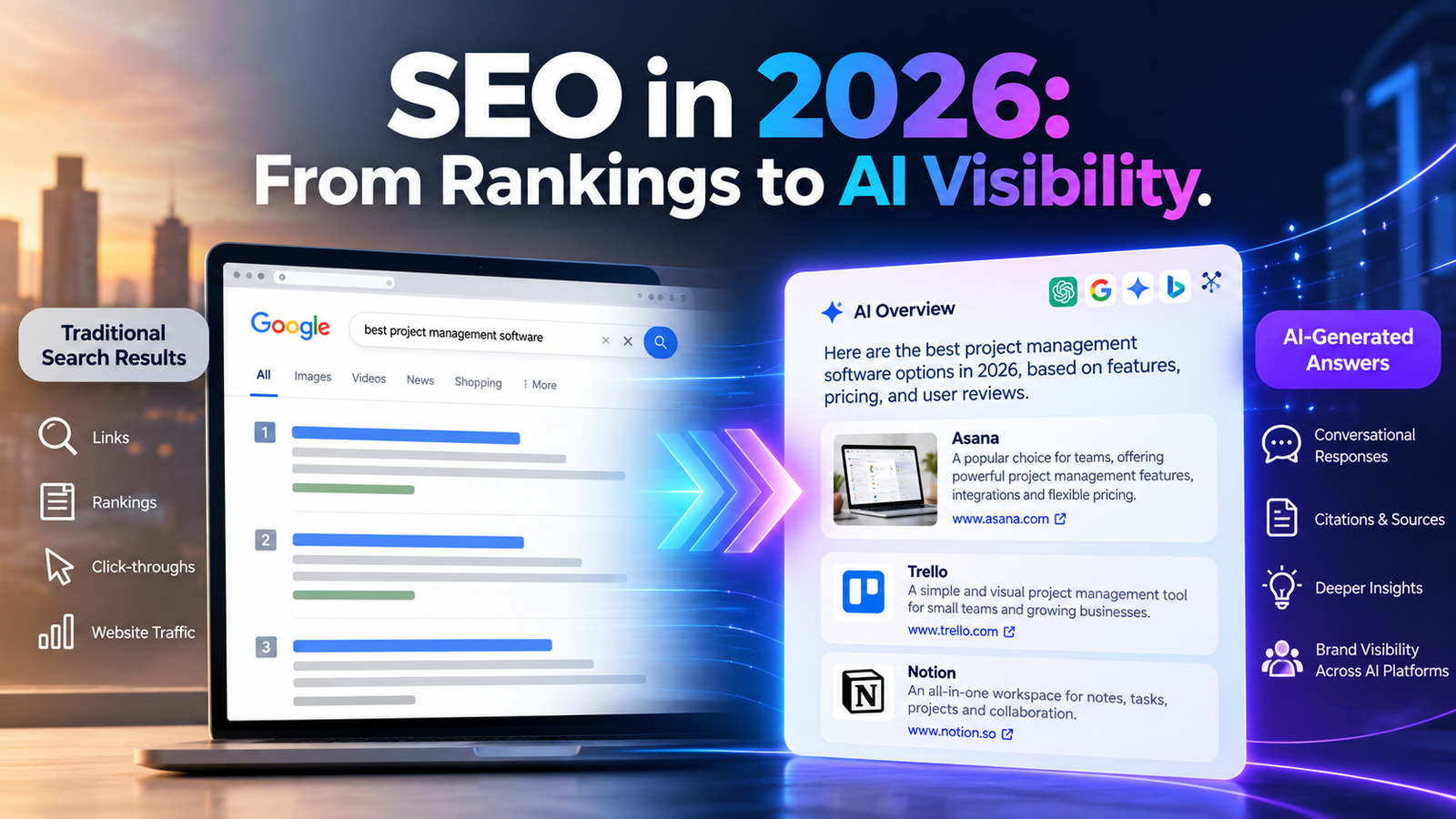
The future of search is not just about ranking higher on Google. It is about becoming a trusted source that search engines and AI-powered platforms can discover, understand, and reference.
The Importance of SEO in 2026 goes beyond traditional search engine rankings. As users increasingly rely on AI-generated answers, conversational search, and intelligent recommendations, businesses must rethink how they build online visibility.
Google reported in 2026 that AI Overviews had more than 2.5 billion monthly active users, while AI Mode had surpassed one billion monthly users. These figures highlight the growing reach of AI-powered search experiences. Source: Google.
For website owners, marketers, and business leaders, the opportunity is clear: optimize content not only to rank in search results but also to provide useful information that AI systems can understand and cite.
So, how can businesses adapt their SEO strategies to stay competitive in 2026?
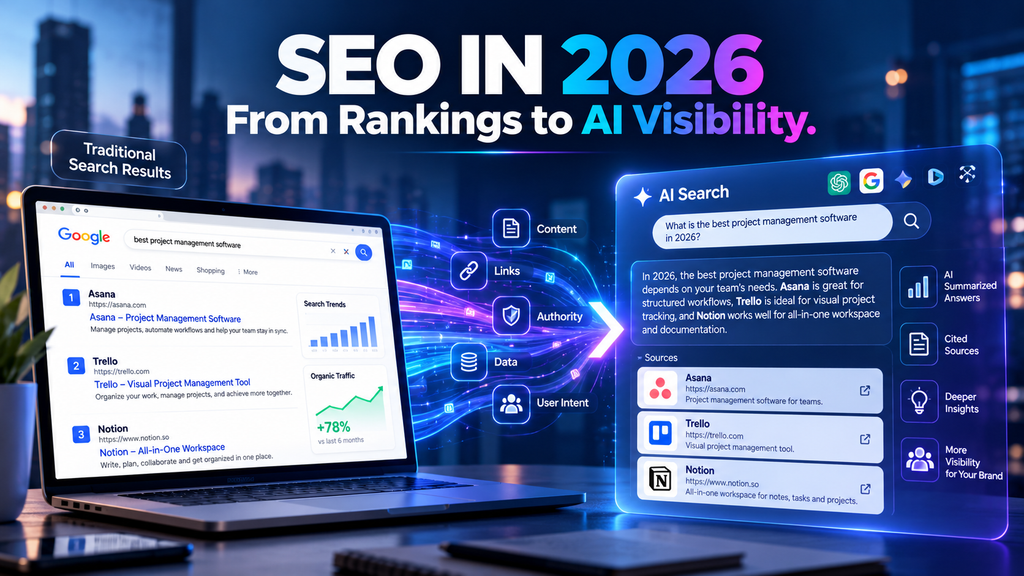
1. Understand How AI Is Changing Search
Traditional search engines primarily present lists of relevant web pages. AI-powered search can also generate summaries, combine information from multiple sources, and respond to complex questions in conversational formats.
This shift is changing how users discover information and interact with websites.
According to a July 2025 study by Pew Research Center, users clicked a traditional search result in 8% of visits when a Google AI summary appeared, compared with 15% of visits without an AI summary. The study examined browsing activity from 900 US adults and should not be treated as a universal click-through rate. Read the research.
The findings highlight an important challenge: visibility does not always translate into website traffic.
Businesses should therefore consider three outcomes:
- Rankings: How well pages perform in traditional search results.
- AI visibility: Whether a brand or website appears in relevant AI-generated responses.
- Business results: Whether visibility generates qualified visits, enquiries, leads, or sales.
These outcomes are related, but they are not interchangeable.
2. Strengthen the Relationship Between AI and SEO
AI and SEO should not be treated as competing strategies. Strong technical foundations and helpful content remain important when optimizing for Google’s AI search experiences.
Google’s official guidance explains that established SEO best practices also apply to AI features such as AI Overviews and AI Mode. There is no special schema markup or separate optimization requirement that guarantees inclusion.
For effective Google SEO in 2026, focus on the fundamentals:
- Make important pages accessible to search crawlers.
- Ensure valuable content can be indexed.
- Maintain clear website navigation and internal links.
- Create useful, original content that addresses search intent.
- Use structured data accurately where appropriate.
- Keep pages technically sound and mobile-friendly.
For example, a digital marketing agency should have dedicated service pages that explain its services, process, expertise, and results. A vague page filled with keywords is less useful to prospective customers than one that answers their questions clearly.
The objective is to build a website that works for both human visitors and search systems.
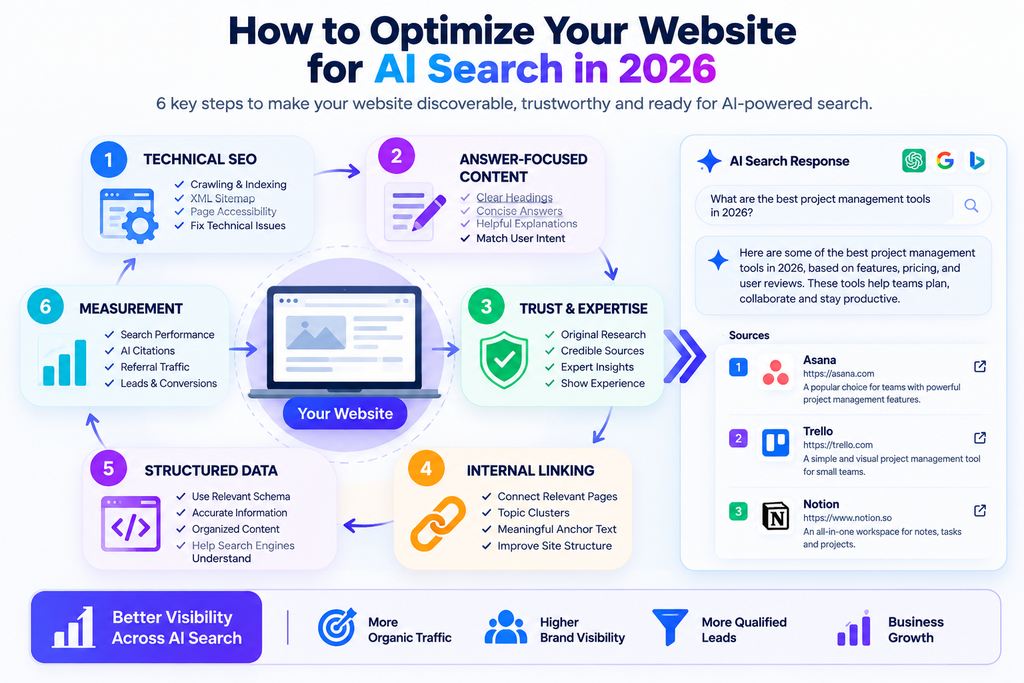
3. Implement SEO for AI Search With Six Practical Steps
Effective SEO for AI search starts with making information easy to discover, understand, and verify.
Step 1: Create answer-focused content
Identify the questions your target audience asks before making a purchase or choosing a service.
Use descriptive headings, direct answers, relevant examples, and supporting explanations. Answer the main question early, then expand on the details.
Step 2: Demonstrate expertise and credibility
Include original insights, practical experience, expert commentary, and reliable references wherever relevant.
Avoid publishing generic articles that repeat information already available across hundreds of websites. Give readers a reason to trust and remember your content.
Step 3: Build relevant internal links
Connect related articles and service pages through meaningful anchor text.
For example, an article about AI search optimization could link to guides covering technical SEO, keyword research, content strategy, and analytics.
This helps readers explore related topics and gives search engines additional context about your website.
Step 4: Improve technical accessibility
Review your robots.txt file, XML sitemap, canonical tags, indexing status, and important page rendering.
Use Google Search Console to identify indexing issues and understand how your pages perform in Google Search.
Step 5: Use structured data appropriately
Implement relevant schema markup when it accurately describes the content on your page.
However, structured data does not guarantee that a page will appear in an AI-generated response. It should support a technically sound website rather than replace good content.
Step 6: Add useful multimedia
Use original images, descriptive alt text, explanatory diagrams, and videos when they improve the reader’s understanding.
For e-commerce businesses, clear product descriptions, specifications, and comparisons can help customers evaluate products more confidently.
4. Understand Generative Engine Optimization (GEO)
Generative Engine Optimization (GEO) refers to efforts to improve a brand’s visibility in responses generated by AI-powered systems.
While traditional SEO emphasizes organic search visibility, GEO also considers whether a brand’s information is represented or cited in AI-generated answers.
Both approaches share important foundations: useful content, accessible pages, relevant evidence, and clear information architecture.
Businesses exploring GEO should focus on:
- Publishing original, evidence-based information.
- Answering specific questions with clear explanations.
- Supporting factual claims with credible sources.
- Maintaining consistent, accurate information about their products and services.
- Building a recognizable and trustworthy online presence.
The distinction in SEO vs AI is not that one replaces the other. Instead, businesses should combine conventional SEO with practical efforts to improve their discoverability across AI-powered search experiences.
There is no universally proven formula for earning AI citations, so avoid tactics that promise guaranteed inclusion.
5. Follow the Right Search Engine Optimization Trends
The most useful search engine optimization trends are those that improve both discoverability and the experience of real users.
Three areas deserve particular attention in 2026.
Conversational search: People can ask longer, more specific questions. Create content that addresses detailed questions and relevant follow-up needs.
Original and trustworthy content: Publish meaningful analysis, firsthand experience, expert perspectives, and verifiable information rather than relying on repetitive content.
Measurement beyond rankings: Evaluate organic visibility alongside qualified traffic, brand discovery, leads, and conversions.
These trends are particularly relevant to startups, agencies, SaaS companies, and e-commerce brands competing for attention in crowded markets.
6. AI Content and SEO: Quality Matters More Than Volume
AI tools can help marketers brainstorm topics, organize research, develop outlines, and improve drafts. However, publishing large volumes of unreviewed AI-generated content is not a sustainable content strategy.
AI content and SEO work best together when automation supports human expertise rather than replacing it.
Before publishing an AI-assisted article, ask:
- Does it provide original value?
- Are its facts and statistics verified?
- Does it answer the reader’s question completely?
- Are the sources credible and relevant?
- Has an editor checked its accuracy, clarity, and usefulness?
For example, an AI-generated article about marketing automation becomes more valuable when a marketing professional adds implementation lessons, real campaign observations, and practical recommendations.
The goal should be to help readers make better decisions, not simply to publish more pages.
7. Measure AI Search Optimization Performance
AI search optimization requires a measurement strategy that goes beyond checking whether a page ranks on Google.
Use a combination of tools and methods to evaluate progress.
| Tool or method | What to measure |
|---|---|
| Google Search Console | Organic impressions, clicks, queries, and page performance |
| Google Analytics 4 | Identifiable referral traffic, engagement, and conversions |
| PageSpeed Insights | Performance and page experience |
| Manual AI search checks | Whether relevant prompts produce brand mentions or website citations |
| CRM or lead tracking | Enquiries, qualified leads, and sales outcomes |
For manual checks, create a consistent list of relevant questions and test them periodically across the AI search platforms that matter to your audience.
Record which brands and sources appear, but remember that responses may vary by query, platform, and time.
Do not treat a single citation as proof of success. Look for patterns and connect visibility data to meaningful business outcomes.
8. Common Mistakes to Avoid
Businesses can waste resources by focusing on AI visibility without addressing the fundamentals.
Avoid these common mistakes:
- Publishing repetitive, low-value AI-generated articles.
- Ignoring crawling and indexing problems.
- Adding schema markup solely in the hope of earning AI citations.
- Repeating keywords unnaturally.
- Neglecting internal links and content updates.
- Reporting AI visibility without measuring traffic or conversions.
- Assuming that appearing in an AI answer guarantees a website visit.
A better approach is to audit existing pages, identify the biggest gaps, improve content quality, and measure the results consistently.
Conclusion: Build a Smarter SEO Strategy for 2026
The Importance of SEO in 2026 lies in building sustainable visibility wherever your audience searches for information. Combine strong technical SEO, helpful content, credible evidence, and thoughtful AI search optimization to create a website that serves users and supports business growth.
Start by auditing one important page, improving its value, and tracking the results.
Want to stay ahead of AI search and digital marketing trends? Follow Marketing Tech Insights for practical insights on SEO, GEO, AI, and marketing technology.
#SEO #AISearch #GEO #DigitalMarketing #MarketingTech